Showing posts with label class. Show all posts

Thursday, July 9, 2009

A Tale of Two Downtowns

Last night I met with the Downtown LA Neighborhood Council’s education committee. I attended so I could bitch share some of the frustrations loft-swelling families are having with the downtown school and park situation. But instead I got a reality check.

At the meeting was a rep from the LAUSD who oversees programs for homeless children and works closely with 9th Street Elementary, which is the school zoned for downtown. He had a lot to say about the school, most of it not good. Approximately 75 percent of the children at the school are homeless. The school has some of the lowest test scores in the LAUSD. In addition, the school has “safety issues” (his wording, so not sure exactly what that means) and they also have a big problem with churn–-kids entering and leaving the school mid-year because of their housing situation. In addition, because LAUSD has eliminated summer school for the elementary grades, these kids are not getting free breakfast and lunch during the summer and there are concerns about their basic nutrition.

One bright spot is the principal, who I'm told has a lot of energy and is working hard to improve the school. But other than that, it’s a pretty dire situation overall. The DLANC is trying to launch volunteer efforts to support the school as well as reach out to businesses based downtown to get some financial support for the school.

In terms of middle class parents downtown, I really think that there is no way in the foreseeable future that middle class families will be able to send their kids to 9th Street. The reality is that the school is struggling to adequately serve the poorest and most at risk kids in the city. With the economic crisis and a lack of a stable population base (which means no stable community of parents to organize and rally around school reform), I don’t see the situation changing any time soon.

If you own a condo and can't sell and move to a neighborhood with better schools, you're going to have to scramble for a charter/magnet school spot or drop a lot of money on private school tuition. Of course, in comparison with what the homeless families are going through, this is not a tremendous hardship. But it is going to be a big disincentive to living/buying downtown for any couples who are planning to have kids.

I’m still going to be doing volunteer work with DLANC and the school because they need all the support they can get. What I'm hoping is that we can reach out to the local business and art community and get them involved in working with 9th Street Elementary, either as volunteers or helping with fundraising events. Even $1,000 would mean so much to them.

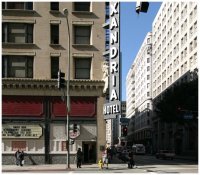
The Downtown community is really two communities, one relatively affluent, the other desperately poor, all sharing a compact neighborhood. It's a situation that you don't see anywhere else in LA and it creates a lot of very difficult problems. I'm not sure how these problems are going to be resolved, especially as the downtown population grows on both sides of the spectrum--people are moving into the new buildings downtown while at the same time more and more people are pushed into homelessness by the economic crisis.

As for us, we're renters and have a lot of flexibility in where we live, and as I said in an earlier post, we've pretty much resigned ourselves to moving in a year or two. But while I'm a part of this community I'm going to do what I can for 9th Street Elementary.

Monday, January 5, 2009

The Alpha and Omega of Downtown

As I've mentioned before on the blog, I grew up in the Bronx in a pretty gritty neighborhood (actually, the same neighborhood as Jennifer Lopez...but try not to hold that against me) and I also went to an Ivy League college. So I've spent most of my life straddling the line between two wildly different worlds. I've had dinners at some of the most expensive restaurants in Beverly Hills and I also shop in Boyle Heights. And I love that my life is that way, that I'm not confined to any one social sphere. That's why I really enjoyed the way Kidlo and I spent our time last Saturday.

In the morning, we went to the LA Athletic Club for a swimming playdate with a mom and daughter who live in South Park. The mom is very cool (she's an active member of the Downtown LA Kids Group) and I had the added bonus of experiencing the luxury of the LAAC. Two swimming pools, a full-sized basketball court, squash courts, two bars, three restaurants, a spa...I could get used to living like this. MB and I are going check out the club on a day pass and see if we can swing a membership (probably not, but I can dream...)

In the afternoon, we got back to reality and shopped at Fallas Paredes on Broadway and 5th. They're basically an overstock store with zero ambiance and incredibly cheap prices. Not the most pleasant place to shop, but a great place to buy kid's clothing. This trip I found a Carter's pajama set and Osh Kosh jeans for $6 each. I hear a lot of complaints about the Broadway shopping district and I understand why--it's not exactly like shopping at Target. But if you're a bargain hunter and patient, you really can find deals.

The LA Athletic Club and Fallas Paredes are a half mile away from each other. I can walk to both from my loft.

That's what I love about Downtown LA. It's really a reflection of how I live my life, all of these subcultures bumping up against each other. There's no other neighborhood in LA like it.

Thursday, June 12, 2008

Class and Mass Transit (Part 1 of 2)

Right now, there’s a battle going on in Cheviot Hills over a proposed light rail line from Downtown to Santa Monica that will run through the community. The Cheviot Hills residents are making safety arguments against the line—cars will be hit at crossings, kids and dogs won’t be able to cross the tracks safely. These arguments don’t hold much water, of course—San Francisco, Portland, Philadelphia and hell, LA itself (the Gold and Blue Lines) manage to have light rail without mass killings of children and animals. It’s not a matter of safety, it’s a matter of class — where do you stand on the socio –economic ladder?

Gas is heading towards $5 a gallon and the word green is being used as a verb, yet mass transit still isn’t being used by the majority of Angelenos. The reason why isn’t simply convenience — when I worked at UCLA, it was both cheaper and faster for me to commute by bus, yet the two other people living in my apartment building who also worked at UCLA still drove to work. Why? People want to be thought of as being environmentally conscious, but as Thorstein Veblen pointed out in The Theory of the Leisure Class, people consume goods and services as a way to signal their social class. And mass transit sends out all kinds of class signals that are problematic for the majority of people in Los Angeles.

So if you’re the average middle-to-upper middle class person in LA, buying a Prius is a socially acceptable way to demonstrate your commitment to the environment. Sure, a Prius isn’t actually all that fuel efficient and it has that pesky battery that eventually has to be recycled so that it doesn’t poison a landfill. But if you’re driving a Prius, you are letting the world know that you are likely college educated, politically liberal, have an interest in the environment (even if you don’t actually know much about environmental issues) and you can afford a down payment and monthly loan payments for a brand new car.

Biking to work is another socially acceptable transit option. It’s not only “green”, it lets people know that you’re fit and it gives you a chance to blow $1,500 on a titanium bike with Shimano gears. Conspicuous consumption, but because you’re not polluting the environment, you can feel smug about spending all that money.

If you look at it in this context, mass transit is a vastly inferior option. Riding the bus doesn’t give you the options for all that class-based signaling. There is no special gear needed to ride the bus, no big outlay of money required. In other words, no way to signal that you belong to the middle or upper class and are not one of the poor masses who are also riding the bus with you.

And speaking of those poor masses, when you ride the bus, you are in a space that puts you all on equal ground. Normally, when middle or upper class people encounter poor people, they do so in a rigidly proscribed context. If you’re at work, the poor people you meet tend to be service workers, people with a clearly defined and inferior status to your own. Many of them even wear uniforms to more clearly delineate the difference.

But when you’re on the bus, it’s an uncontrolled environment. Those poor people don’t have to be polite or deferential to you. And this is a dangerous situation for someone who is middle or upper class. Not physically dangerous (though of course people in those classes do fear being assaulted if they encounter poor people outside of an employment context), but dangerous in the sense that by mixing with the poor, they lose class status. And as Veblen pointed out, losing class status is comparable to death. People will go into debt, even risking bankruptcy, in order to avoid losing class status.

So what does this all mean for mass transit and for communities like Downtown? More on this in the next post.