Wednesday, June 18, 2008

Sign of the times


Saw this sign posted in the elevator this morning. Looks like a lot of people aren't paying their rent on time. Is it because of gas prices? They're broke because they just moved? General irresponsible dumbassery? Dunno.

Tuesday, June 17, 2008

Art Walk in 90 Seconds

(edited because I figured out how to embed Flickr videos)


A stop motion video of Art Walk made by tradica and forwarded by Bert Green.

The last art walk was fun. We brought Kidlo with us for the first time and he was a champ even though we kept him up way past his bed time. We went for a drink at 626 Reserve and I was worried about bringing Kidlo inside, but the bartender was all, "Hey, I have a four-year-old son! C'mon in!" Lots of cool art including a gallery on Spring near 5th that had large paintings that looked like photo enlargements (can't remember the gallery or artist--if anyone knows who this was, let me know). Also, lots of other kids--I counted five other baby carriages and a few older kids too. It's cool to be able to expose Kidlo to a little culture without anyone being bent out of shape.

Thursday, June 12, 2008

Class and Mass Transit (Part 1 of 2)

Right now, there’s a battle going on in Cheviot Hills over a proposed light rail line from Downtown to Santa Monica that will run through the community. The Cheviot Hills residents are making safety arguments against the line—cars will be hit at crossings, kids and dogs won’t be able to cross the tracks safely. These arguments don’t hold much water, of course—San Francisco, Portland, Philadelphia and hell, LA itself (the Gold and Blue Lines) manage to have light rail without mass killings of children and animals. It’s not a matter of safety, it’s a matter of class — where do you stand on the socio –economic ladder?

Gas is heading towards $5 a gallon and the word green is being used as a verb, yet mass transit still isn’t being used by the majority of Angelenos. The reason why isn’t simply convenience — when I worked at UCLA, it was both cheaper and faster for me to commute by bus, yet the two other people living in my apartment building who also worked at UCLA still drove to work. Why? People want to be thought of as being environmentally conscious, but as Thorstein Veblen pointed out in The Theory of the Leisure Class, people consume goods and services as a way to signal their social class. And mass transit sends out all kinds of class signals that are problematic for the majority of people in Los Angeles.

So if you’re the average middle-to-upper middle class person in LA, buying a Prius is a socially acceptable way to demonstrate your commitment to the environment. Sure, a Prius isn’t actually all that fuel efficient and it has that pesky battery that eventually has to be recycled so that it doesn’t poison a landfill. But if you’re driving a Prius, you are letting the world know that you are likely college educated, politically liberal, have an interest in the environment (even if you don’t actually know much about environmental issues) and you can afford a down payment and monthly loan payments for a brand new car.

Biking to work is another socially acceptable transit option. It’s not only “green”, it lets people know that you’re fit and it gives you a chance to blow $1,500 on a titanium bike with Shimano gears. Conspicuous consumption, but because you’re not polluting the environment, you can feel smug about spending all that money.

If you look at it in this context, mass transit is a vastly inferior option. Riding the bus doesn’t give you the options for all that class-based signaling. There is no special gear needed to ride the bus, no big outlay of money required. In other words, no way to signal that you belong to the middle or upper class and are not one of the poor masses who are also riding the bus with you.

And speaking of those poor masses, when you ride the bus, you are in a space that puts you all on equal ground. Normally, when middle or upper class people encounter poor people, they do so in a rigidly proscribed context. If you’re at work, the poor people you meet tend to be service workers, people with a clearly defined and inferior status to your own. Many of them even wear uniforms to more clearly delineate the difference.

But when you’re on the bus, it’s an uncontrolled environment. Those poor people don’t have to be polite or deferential to you. And this is a dangerous situation for someone who is middle or upper class. Not physically dangerous (though of course people in those classes do fear being assaulted if they encounter poor people outside of an employment context), but dangerous in the sense that by mixing with the poor, they lose class status. And as Veblen pointed out, losing class status is comparable to death. People will go into debt, even risking bankruptcy, in order to avoid losing class status.

So what does this all mean for mass transit and for communities like Downtown? More on this in the next post.

Wednesday, June 11, 2008

Pot, meet kettle

Dear Neighbor,

I can certainly understand why you'd be upset that our neighbor's Lakers party lasted until 4 a.m. However, it was not the party that woke me last night. It was you shrieking, Stop making so much motherfucking noise! I'm trying to sleep you stupid motherfuckers! Next time, try some earplugs and a shot of bourbon instead.

Smooches,
Li

Monday, June 9, 2008

Exurbs in trouble

From the blog Calculated Risk:

Last week I mentioned that 15% of the homes in Temecula, CA were REO or in foreclosure. Temecula is a fairly isolated town (see map), and the city is very dependent on construction and/or long commutes. The combination of the housing bust, plus high oil prices, is hitting exurban towns like Temecula very hard.

From Bloomberg: Wealth Evaporates as Gas Prices Clobber McMansions, SUV Makers

``At $4 per gallon gas, $125 per barrel oil and $10 per million Btu natural gas, a lot of activity becomes uneconomical,'' says Mark Zandi, chief economist at Moody's Economy.com ...

The lifestyle of the exurban commuter may be one casualty.

Emerging suburbs and exurbs -- commuter towns that lie beyond cities and their traditional suburbs -- grew about 15 percent from 2000 to 2006, nearly three times as fast as the U.S. population, as Americans moved further out in search of more affordable houses or the bigger ones that are sometimes derided as McMansions.

``It was drive until you qualify'' for a mortgage, says Robert Lang, director of the Metropolitan Institute at Virginia Tech in Alexandria, Virginia. ``You can't do that anymore. Your cost of transportation will spike too much.''

Assuming the price of gas stays around $4 a gallon or spikes higher, places like the Antelope Valley and Inland Empire may be looking at a permanent contraction. Meanwhile, Downtown's gentrification is likely to continue or accelerate, despite the downturn (though I don't see condo sales recovering anytime soon). Of course, Downtown isn't for everyone, but communities with good access to public transportation and that are close to employers are positioned to do better in the long term. Density is a dirty word for a lot of Angelenos, but for better or worse, it looks like suburban sprawl simply isn't economically sustainable for the average family.

I've used maybe half a tank of gas in the past month and that plus the decrease in rent means I'm feeling pretty happy about moving down here.

MySpace? Really?

The Alexandria has a MySpace page. Here's a sample of the About Me:

Live In A Legend*************** ***************Designed by famed architect John Parkinson, whose creative power produced such notable projects as Union Station, Los Angeles City Hall, and The Los Angeles Memorial Coliseum, The Alexandria exudes confidence that not only comes with brilliant design but with a charm and personality all her own. ***************Hollywood fell in love with The Alexandria from the start. Legends from Charlie Chaplin, Mae West, and Humphrey Bogart to Rudolph Valentino, Clark Gable and Greta Garbo called her home. Three U.S. Presidents and foreign dignitaries followed suit making The Alexandria one of the most famous buildings in the city. ***************Now, you have the opportunity to live in the same residences as these legendary celebrities and make a history all your own. Currently in renovation, the new Alexandria will offer a charming, affordable and secure environment in the heart of the evolving downtown Los Angeles community. This is an opportunity to get in on the ground floor of the new urbanism movement and a growing, citywide revitalization effort. +++++A Facelift for our Beauty+++++ ***************The Alexandria is receiving a $14 million renovation including manicured common areas with fashionable furnishings for your enjoyment and entertaining, and our popular ‘micro-lofts’ will feature all new appliances, floor coverings, ceiling fans and light fixtures. Additional plans include a fitness center, business center, lobby diner, black box room for resident performances & exhibitions, and storage lockers for your convenience. Construction begins in the fall of 2006 and is scheduled for completion in the spring of 2009. ***************All new residents must meet affordable income guidelines but will benefit from rents starting in the $450 per month range including utilities.
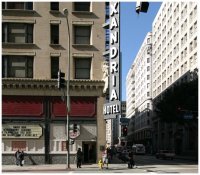

Hm, no mention of the crack dealers hanging out by the front door. An oversight, I'm sure.